
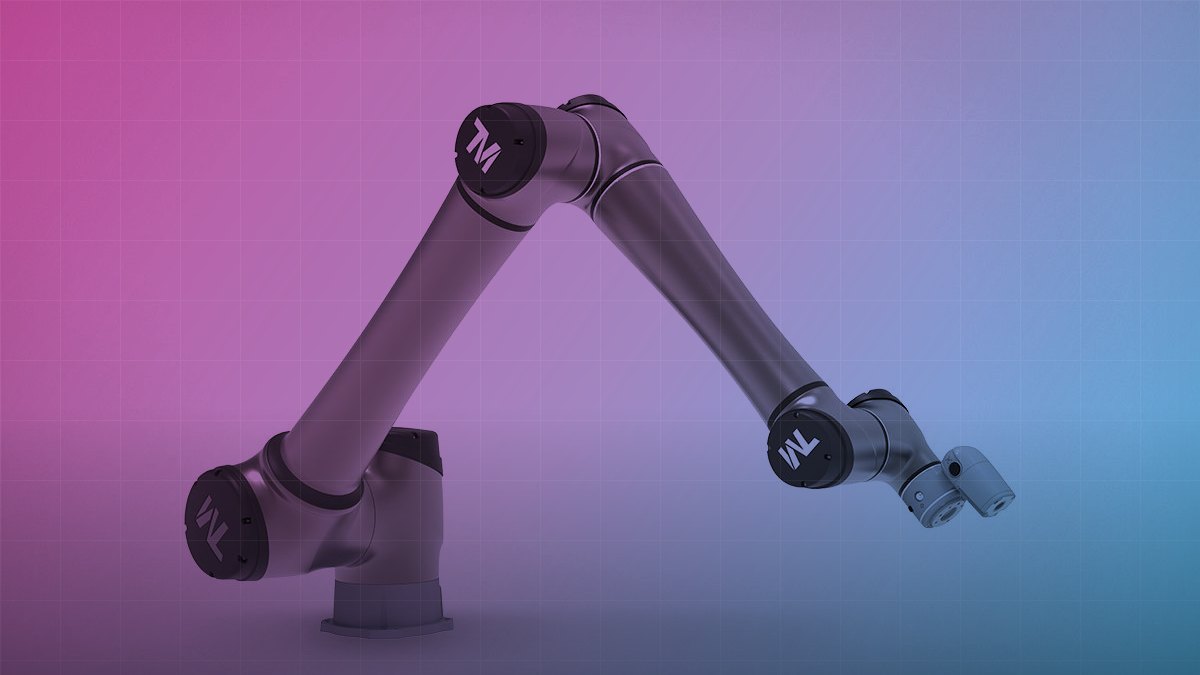
Every week we walk factory floors across Indonesia, and every week we hear the same seven questions about robotic arms — from plant managers, owners and line supervisors alike. They are good questions: cost, payback, programming, safety, people. Here are the straight answers we give in those meetings, with real numbers from the TM AI Cobot cells we deploy with QSD Indonesia.
1. What can a robotic arm actually do on my line?
More than most first-time buyers expect. The workhorse applications we deploy daily:
- Pick & place and machine tending — loading CNC machines, presses and moulding machines around the clock.
- Palletizing and packaging — end-of-line case packing and pallet building up to 35 kg per cycle.
- Assembly and screw driving — repeatable torque and position for electronics and appliances.
- Dispensing and welding — smooth, vision-corrected paths at ±0.03 mm repeatability.
- Quality inspection — a built-in 5 MP camera plus AI turns the same arm into a 100% inspection station.
The pattern behind all of them: tasks that are repetitive, precise, heavy or dull. If a job makes people bored, tired or injured, it is probably a robot arm job. A quick test: walk your line with a stopwatch and mark every task where an operator repeats the same motion more than fifty times a shift. Those are your candidates, and a twenty-person line usually has three to five of them.
2. How much does a robotic arm cost?
The honest answer has two layers. There is the arm itself, and there is the working cell around it — gripper, fixtures, conveyor interfaces, integration and a safety assessment. Budget for the cell, not the arm: the arm is usually only 30–40% of the total. The good news is where cobots save against a traditional robot — no safety fence in most applications, no dedicated programmer, and far less floor space, which is exactly where traditional robot budgets explode. For a figure on your own line, ask us for a quote; it depends heavily on payload, reach and how much integration the job needs.
3. How fast does it pay for itself?
Across the cells we commission, payback typically lands in 6–18 months. The single biggest lever is shifts: an arm that runs two to three shifts pays back two to three times faster — it does not get tired at 2 a.m. The other levers are labour cost per operator covered, scrap and rework reduction (AI vision catches defects before they ship), and uptime. Ask any vendor for a payback model computed on your parts, your shifts and your wages — if they cannot produce one, keep walking.
“The robot that pays back fastest is not the cheapest one — it is the one running the night shift.”
4. Is it hard to program? Do I need robotics engineers?
This is the fear that stops most first deployments, and it is ten years out of date. Modern cobots are programmed with flow-chart style, no-code software: on the TM AI Cobot, TMflow lets an operator drag blocks — move, pick, inspect, place — into a flow, and hand-guiding means you physically move the arm to teach positions. Your existing team can re-teach a task in minutes and build a new one in an afternoon after basic training. Robotics engineers are only needed for complex multi-robot lines — and for that, that is what your integrator is for.
Put numbers on it: on our Indonesian installs, an operator learns to teach a conveyor-to-fixture pick in two to four hours, a machine-tending cycle with the door opening and closing in four to six, and a single-SKU palletizing pattern in two to three. The specialist you needed in 2015 is, in 2026, the operator who spent a week learning TMflow.
5. Is it safe for my people to work next to one?
Collaborative robots were invented precisely for this. Under ISO 10218 and ISO/TS 15066, a cobot limits its force and speed: torque sensing in every joint stops the arm the moment it meets unexpected resistance, and speed-and-separation monitoring slows it when a person approaches. After a documented risk assessment, most cobot cells run without any fence at all — people hand parts to the robot and take them back. The record backs it up: manufacturers consistently report safety improving after deployment, because the robot absorbs the lifting, the repetitive strain and the hazardous steps.
One thing to insist on: ask to see the risk assessment. A proper one runs fifteen to twenty-five pages and covers the force and pressure limits, the speed-and-separation zones, pinch and trap points, where the E-stops sit, what the arm does on a power loss, and the maintenance steps that keep the safety functions working. If a vendor hands you a single page, push back.
6. Will it replace my workers?
The question everyone asks quietly. What we see on real factory floors: robot arms take over the tasks people were already leaving — night shifts, heavy lifting, mind-numbing repetition — while the people move up to running the robot, quality and line supervision. Most of our customers automate because they cannot hire enough operators for those roles, not to reduce headcount. The operator who loaded the machine becomes the person who programs the robot that loads three machines. One Surabaya automotive supplier kept the same headcount after two cells went in — the three hard-to-fill night-shift operators became cell supervisors, and the line ran 22 hours a day instead of 16. The plant manager told us the real win was taking on two contracts they had previously turned away for lack of capacity.
7. How do I get started — and how long does it take?
Simpler than most expect. The path we run with customers: a free line assessment to find the one task with the clearest payback; an application study with simulation on your actual parts; then installation. A straightforward pick & place or palletizing cell typically goes from order to production in 4–12 weeks, with the install itself measured in days. Start with one cell, prove the numbers, then scale — the same arm can be redeployed to a different station next quarter if your product mix changes.
Notes for an Indonesian rollout
A few specifics worth knowing before you plan the schedule. Collaborative robots usually classify under HS code 8479.50, and import duty often falls in the 0–5% band when the robot is sourced through TM Robotics' regional hub; we handle the customs paperwork and give your finance team the documentation. Standard cells ship from the regional hub in four to six weeks, plus two to three weeks of sea freight to Jakarta — or air freight if you are in a hurry. Field engineers work out of Jakarta (Cibitung) and Surabaya, with next-day on-site response for the Jakarta area and around 48 hours for Surabaya, Semarang and Bandung. First-cohort operator training is included in Bahasa Indonesia, and a 12-month warranty is standard, with extended cover available.
Seven questions, seven answers — and an eighth worth asking any vendor: who answers the phone in year three? Buy the local support, not just the arm. Future Engineering AI and QSD Indonesia deliver, integrate and service TM AI Cobots across Indonesia, in Bahasa Indonesia, English and Japanese.
Have an eighth question?
Book a free line assessment — we will answer every question with numbers from your own line, not a brochure.
Request my free assessment